Naming your zine
A title is read before any picture, so it shapes how the pictures are seen. It doesn’t need to be clever.
What a title does
A reader meets the title before the first photograph, and carries it through every page. Most books have one, on the title page if nowhere else, and for a zine with no other text it may be the only words the reader gets.
The title is also where you decide how the pictures are approached. Silke Güldner, who advises photographers, reports Alec Soth’s view that a project needs its title as a frame, and that students often work for a year or two without one.
One word can do a great deal. In the 1970s Larry Sultan and Mike Mandel searched the files of corporations, the police, research laboratories and government departments, looking for photographs made and used as plain records. They chose 59 and published them in 1977 as Evidence. The word asks you to look at each picture as proof of something, and leaves you to wonder what.
Kinds of title
Say exactly what it is. Twentysix Gasoline Stations is a plain count of what’s inside. The Victoria and Albert Museum records that Ed Ruscha’s first book came out of a play on words, and that the artist liked the word “gasoline” and the quality of “twenty-six”. A plain title can be dry or funny, and it tells the reader that nothing is being dressed up.
Name a place or a time. A street, a town or a year gives the reader somewhere to stand. It works well when the place is what holds the pictures together.
Choose one word that changes the reading. Evidence is the example above. A single word leaves plenty of room, so it helps if it’s a word the pictures can live up to.
Use a phrase with a feeling in it. Wesley Verhoeve’s book NJV1 has the subtitle the shadows will be behind you if you walk into the light. Verhoeve writes that it suggests a more personal book than the earlier NOTICE.
Take something from inside the work. A sign in one of the pictures, something overheard while photographing or a family saying can make a title that belongs to this zine and no other.
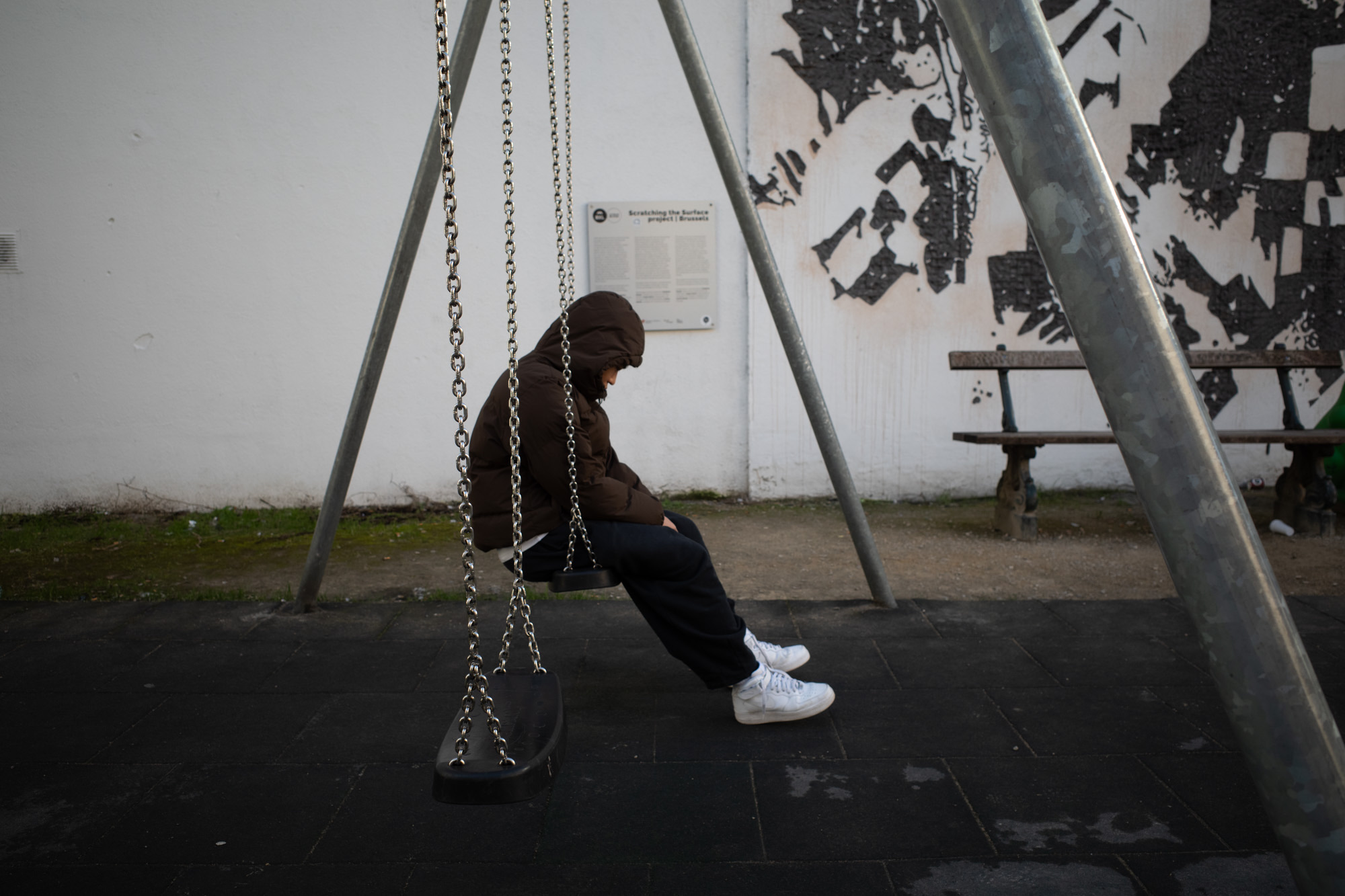 The playgroundStill waiting
When to name it
Practice varies. Ruscha had the title before any of the photographs. Güldner suggests a working title early on: it doesn’t have to be perfect, it can change later, and it helps you stay focused on the idea.
Working titles often do change. Gregory Halpern’s King, Queen, Knave, which took about two decades, was first a project called 19 Winters / 7 Springs, as Noah Waldeck recounts.
Name it early. Rename it once you know what it is.
If you’ve worked out what your zine is about, look at that sentence for a title. There’s often a word or a phrase in it worth keeping.
Testing a title
Say it aloud, as you would to someone who asked what you’re working on. If it’s awkward to say, it will be awkward for them to pass on.
See it at the size it will be. A title that looks fine across a screen may wrap badly on an A5 cover, and it will be much smaller again when someone sees the cover in a post on their phone.
Ask someone what they’d expect from the title alone, then show them the pictures. A title doesn’t have to explain, but a reader should feel that the two belong together.
Search for it, with and without your name, so you know whether another book already uses it. Then ask someone to check the spelling. Grant Scott advises having someone check a book’s grammar, spelling and punctuation, and the title is the first thing anyone will read.
Settle on the title before you pay for the print-ready PDF, because any change after paying makes it a new zine.
Sources and further reading
- Victoria and Albert Museum, record for Twentysix Gasoline Stations: Ruscha on the title coming first and the play on words.
- ARTBOOK | D.A.P., Larry Sultan & Mike Mandel: Evidence (2017): the archives searched, the 59 photographs chosen and what they were made for.
- Silke Güldner, “What, why & how? Your photo project needs more than good pictures” (2 November 2026): working titles, and Alec Soth on titles.
- Noah Waldeck, “Lessons on long-term photo projects” (18 March 2025): the earlier title of Gregory Halpern’s King, Queen, Knave.
- Wesley Verhoeve, “How to write and use text in your photo book or zine” (26 May 2024), Process: the subtitle of NJV1; and “When do pictures need words?” (23 August 2026): the title page.
- Grant Scott, “How to produce a photo book: a simple 12-step guide”, United Nations of Photography (31 August 2026): having someone check the text.