Making and testing a dummy
A rough printed copy shows what a screen can’t. How to make one at home, and what to look for once it’s in your hands.
What a dummy shows
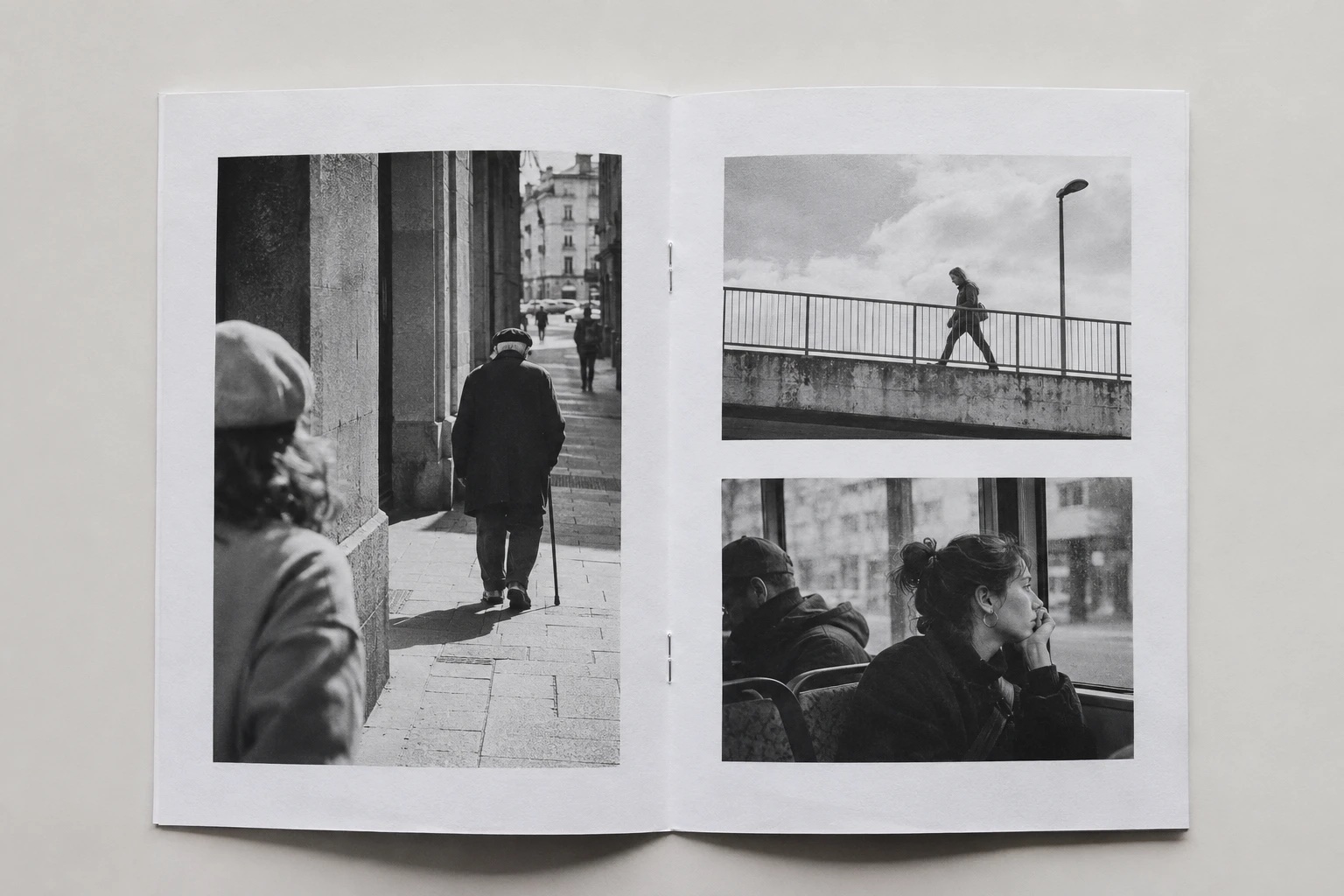
A dummy is a rough printed copy of your zine, made before the real one. Photobook makers have used them for as long as there have been photobooks, under several names: a dummy, a maquette, a mock-up. Whatever it’s called, it does one job. It turns a sequence on a screen into a thing you can hold, open and turn.
Paper shows what a screen can’t. On screen every spread (two facing pages) sits flat and whole. In your hands, the fold runs down the middle of it, the pages have a front and a back, and a page turn hides one picture while it reveals the next. A photograph that crosses the fold loses something in the gutter. A small picture that looked fine on screen may look lost on the page, or a title may be bigger than it needs to be. None of this is visible until it’s printed.
The photographer Harvey Benge suggests making a dummy as close as possible to the finished book, because it gives “a sense of the outcome of the work on both a visual and tactile level”. The photographer Maria Kapajeva puts the same idea from the reader’s side: dummies give “an insight into the experience you offer your reader”. You stop being the person who made the zine and become, for a few minutes, the person reading it.
Dummies that became books
Some of the best-known photobooks began as dummies made by hand. In 1953, at the suggestion of the curator Edward Steichen, Ed van der Elsken built a book from his unordered contact prints of life in Saint-Germain-des-Prés. The curator Tamara Berghmans, writing for The Eyes, describes three dummies: the first loose-leaf, with photographs mounted on yellow and black boards and captions written between them; the last with the photographs mounted on white paper and no text at all, carrying pencil notes from the book’s designer. The storyline of the book was there by the first dummy. The form of the book arrived over the next two. It was published in 1956 as Love on the Left Bank.
Half a century later, Alec Soth told the British Journal of Photography that in spring 2003 he made 50 inkjet books of Sleeping by the Mississippi and gave them away. “People responded to them very quickly and soon publishers were interested,” he said. The book came out the following year.
Today there is a prize for dummies alone. The Fotobookfestival Kassel has given its Dummy Award since 2010 for the best photobook mock-up of the year; the winning dummy is produced and published, and the shortlist tours as an exhibition. A dummy, in other words, is not a lesser version of a book. For many makers it is the book, before it goes to print.
Making one at home
You don’t need a printer who makes books. A home printer, a stack of ordinary A4 paper and a stapler will do, and the first dummy can be rougher than you think.
In the studio, download the free proof: a PDF set up for A4 that you print at home. For an A5 zine, each A4 sheet folded in half makes four pages, two on each side. That is why stapled zines come in page counts that divide by four: 16, 20, 24 and so on, up to 40 pages. A 24-page zine is six sheets.
Most print dialogues have a booklet setting. It puts two pages on each side of every sheet, in the order a folded booklet needs, and prints both sides. Fold the stack down the middle, press the fold with the back of a spoon or a ruler, and staple twice through the fold. A long-arm stapler reaches the middle of an A4 sheet; without one, open the stapler flat and press the staples through, then fold the legs over by hand.
If booklet printing isn’t an option, print the pages one to a sheet, stack them in order and clip them at the left edge. The publisher Dewi Lewis calls this kind of thing a dummy “in its loosest sense”: something where the work is sequenced, printed and lived with. It won’t show you the fold, but it will show you the order, the sizes and the page turns, and that is most of what a first dummy is for.
Keep it cheap. Draft quality and plain paper are fine for the first few; a dummy is for finding what’s wrong while it costs nothing to fix. When the sequence has settled, one dummy on heavier paper, at full quality, will tell you how the finished zine might feel. If you make it from the full stack of sheets, you will notice that the inner pages push out a little beyond the outer ones once folded. Printers call this creep and allow for it when they trim, so there is no need to.
A dummy is for finding what’s wrong while it costs nothing to fix.
Reading it
Read the dummy the way a reader would: from the front cover, at the pace it asks for, without stopping to explain anything to yourself. Then go back through it with a pencil and mark anything that bothers you, on the page where it happens. A picture that should be bigger or smaller. A pair that doesn’t belong together. A turn that comes too soon, or a run of pages where your hand speeds up. Words that are hard to read at this size. A photograph whose subject sits in the fold.
Then leave it alone for a while. Dewi Lewis describes the work as “continually printing out the images, putting them in a sequence, and living with it”, so that the gaps and strengths show themselves as you go. The photographer Arnis Balčus suggests making a dummy even if it is only for yourself, so you can see how the book works and live with it for a while. A sequence that felt finished on the day it was printed often looks different a week later, picked up off the kitchen table.
It helps to let someone else read it too. The photographer Laura Kuusk suggests letting “other trustworthy people see the dummy before you finalize and print”. Watch where they slow down and where they skip. They will not read it the way you do, and that is the point.
Expect to make more than one. The photographer Peter Puklus mentions “a few failed dummies” on the way to one of his books, and van der Elsken made three. Each one shows a little less wrong than the last. When you reach the one you would be happy to hand to a stranger, the zine is ready for the print-ready PDF.
Sources and further reading
- Tamara Berghmans, “Love on the Left Bank”, The Eyes #8, Bibliomania (15 November 2018): Ed van der Elsken’s three dummies.
- British Journal of Photography, “Alec Soth is Sleeping by the Mississippi” (November 2017): the 50 inkjet books.
- Fotobookfestival Kassel, “About”: the Dummy Award, given since 2010.
- Harvey Benge, “The photobook: some thoughts on editing and sequencing” (11 March 2012): a dummy as close as possible to the final book.
- British Journal of Photography, “How to create a ground-breaking photobook” (2017): Dewi Lewis on the loose dummy and living with it.
- FK Magazine, “FK asks – How to make a photobook?” (5 October 2018): Maria Kapajeva, Arnis Balčus, Laura Kuusk and Peter Puklus on dummies.